 THE ALBANIAN NOTEBOOK
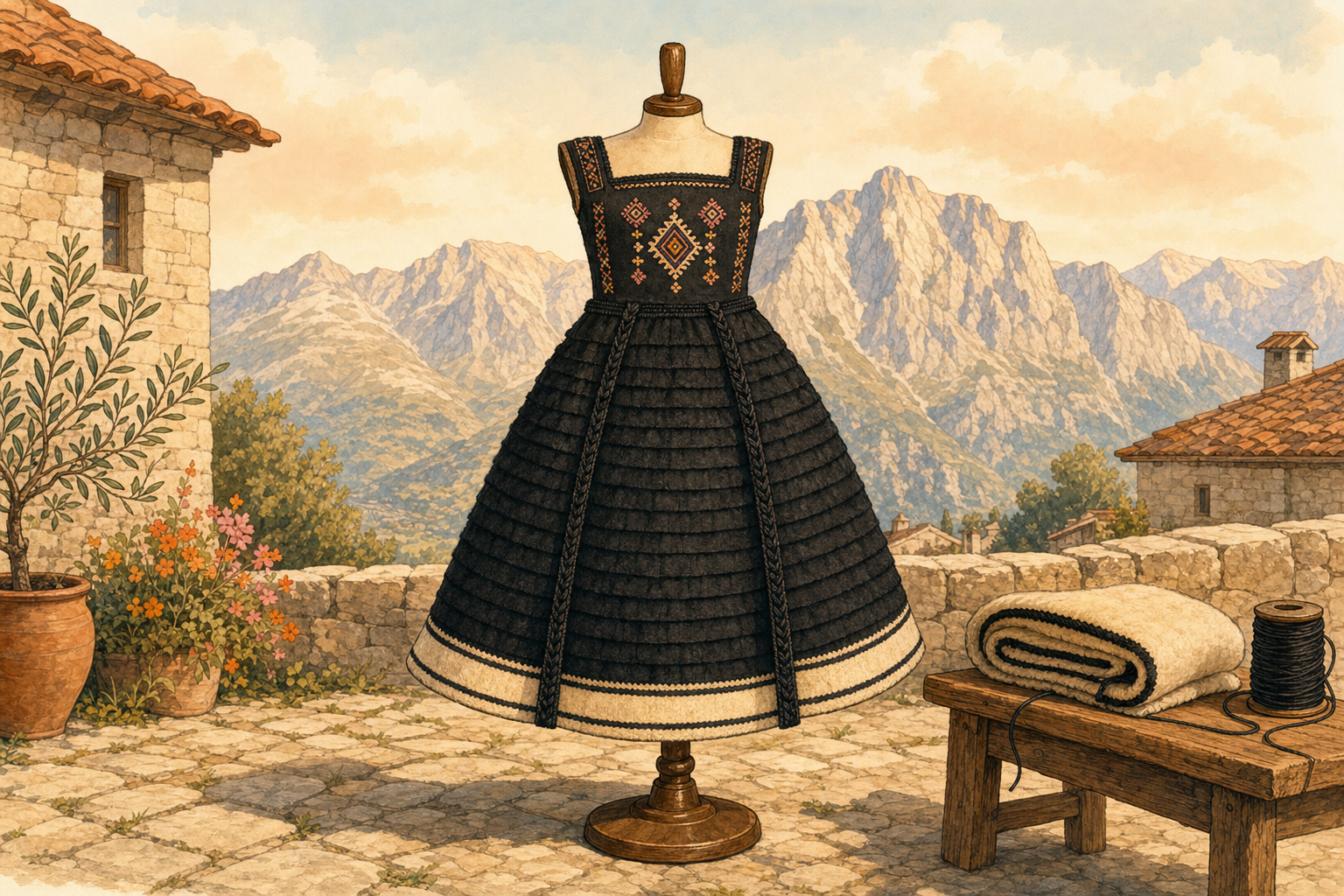
A few years ago, in the courtyard of the church in Bajzë, in Malësi e Madhe, a group of young people set out the area's traditional clothes. The piece that drew the most attention was the xhubleta, a dark, bell-shaped dress that sways as the wearer walks. A local teacher told reporters it had left everyday use almost seventy years earlier, yet it remained part of the heritage of the highland women and girls.
So what exactly are you looking at?
A dress that once said who you were
The xhubleta is made by hand and was worn by women and girls in the northern highlands. Girls began wearing it every day from puberty, and the dress showed the wearer's social and economic standing. Everyday use declined from the 1960s. Women working on the collective farms of the socialist period found it impractical, and collectivisation also made raw materials scarce. In 2022 the dress and its craft were listed as heritage in need of urgent safeguarding. The plans include a booklet on how it is made and a training centre in Malësi e Madhe.
Three words to read it with
1. Xhubletë / xhubleta. In Albanian, xh sounds like the English j, so the word is roughly joo-BLEH-tah. Xhubletë means "a xhubleta", and xhubleta means "the xhubleta". Në foto, ajo vesh xhubletën e gjyshes. "In the photo, she's wearing her grandmother's xhubleta."
2. Shajak. This is woven, felted wool. Preparing the shajak comes first, followed by cutting, sewing and embroidering the figures.
3. Iva. These are the strips that build up the skirt's ripples. Once you notice them, you'll see that not every xhubleta looks the same. In Malësi e Madhe the bell is wide and wavy, often finished with a white band at the hem. The Dukagjin–Pult type is narrower and more compact.
What about "4,000 years old"?
You'll often hear that the dress is four thousand years old. The idea rests on a resemblance to ancient figurines with bell-shaped skirts. It's a popular theory, not a settled fact, and readings of the embroidered symbols are also interpretations. The documented part is the craft itself, which today is carried mainly by older women in the villages of the Albanian Alps.
Try it
If you see a xhubleta at a museum or festival, you could say: Sa e bukur kjo xhubletë! "What a beautiful xhubleta!" The phrase uses xhubletë because kjo ("this") already points to the dress. Then look at the hem. A wide, rippling bell with a white band is likely from Malësi e Madhe.
Keep learning
Explore more articles →