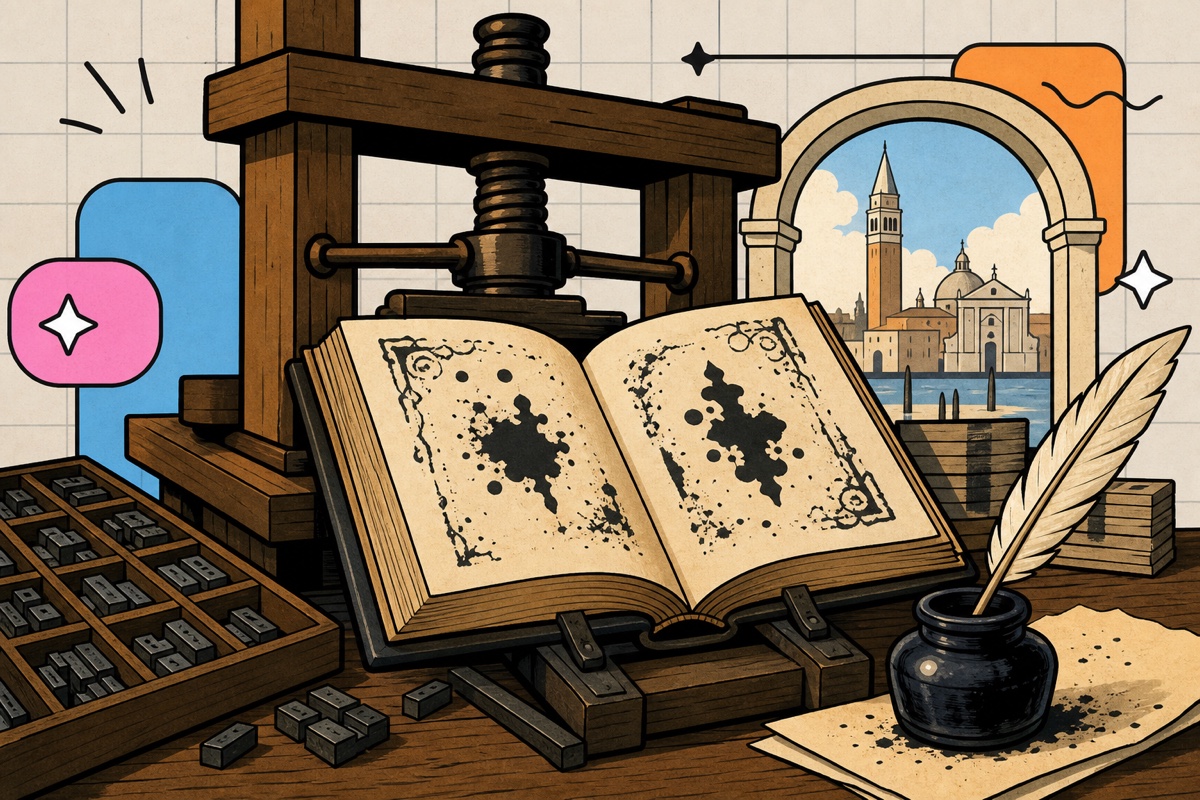
 THE ALBANIAN NOTEBOOK1555
Every language has its milestones - moments that define its history and preserve its identity for future generations. For the Albanian language, one of the most significant of these milestones is the publication of Meshari (The Missal) by Gjon Buzuku in 1555, the oldest known printed book in Albanian.
Although Meshari is a religious text, its importance extends far beyond its liturgical purpose. It marks the beginning of Albanian written literature and provides the earliest substantial evidence of the Albanian language in print. Thanks to Gjon Buzuku's remarkable work, we are able to study the vocabulary, grammar, and structure of Albanian as it was spoken nearly five centuries ago.
A book written for the people
Very little is known about Gjon Buzuku himself. He is believed to have been a Catholic priest who translated the principal parts of the Catholic liturgy into Albanian so that ordinary believers could understand and participate more fully in religious services. In the book's preface, Buzuku explains that his motivation was to serve his people by making religious texts available in their native language - a vision that reflects both his devotion and his deep respect for the Albanian language.
The book was printed in 1555, most likely in Venice, one of the most important centres of printing in Europe during the Renaissance. It consists of over 180 pages and is written in the Gheg dialect, using a Latin-based alphabet enriched with additional characters to represent Albanian sounds. This makes Meshari not only a religious document but also an invaluable linguistic treasure, offering scholars unique insight into the historical development of Albanian.
One surviving copy
What makes Meshari even more extraordinary is its rarity. Only one complete copy of the original edition has survived through the centuries. Today, it is preserved in the Vatican Apostolic Library, where it remains one of the most precious monuments of Albanian cultural heritage.
For linguists, historians, and anyone interested in Albanian culture, Meshari is far more than an old book. It is evidence that the Albanian language had already reached a sophisticated written form in the sixteenth century. It demonstrates the determination of Albanians to preserve their language and identity during a period of significant political and religious change in the Balkans.
“Meshari is not simply the first book in Albanian; it is the first printed testimony to the enduring spirit of the Albanian language.”
A tradition that continues
Today, Meshari continues to inspire students, teachers, researchers, and lovers of the Albanian language around the world. Every person who learns Albanian becomes part of a linguistic tradition whose written history stretches back nearly five hundred years. Understanding Meshari means appreciating not only the origins of Albanian literature but also the resilience and continuity of one of Europe's oldest languages.
As we study Albanian today, we are building upon a foundation laid by Gjon Buzuku in 1555. His work reminds us that language is more than a means of communication - it is the memory of a people, the carrier of culture, and a bridge connecting generations across centuries.
Keep learning
Explore more articles →